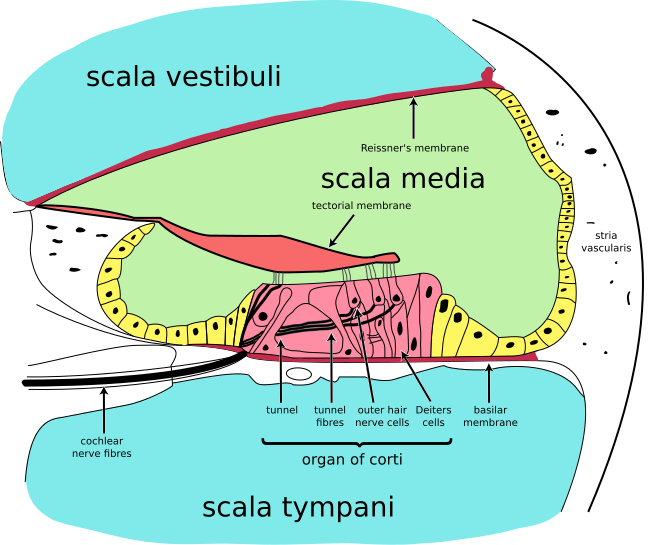
This is a gooey liquid that is inside the bony labryinth we learned about.
The perilymph helps control the electrical messages that are sent to the brain when the ear hears a sound and turns it into a message.
Let's learn about some more countries in North America.
One country is called Nicaragua!
This country borders Honduras, Costa Rica, and both the Pacific and Atlantic oceans.
It is about 50,000 square miles and about 6 million people live there.
People in Nicaragua speak Spanish.
The flag of Nicaragua is sideways stripes of blue, white and blue, with the a triangle in the middle of the white.
The two blue stripes are for the Pacific Ocean and Caribbean Sea.
The white is for peace, and the triangle is the coat of arms for Nicaragua.
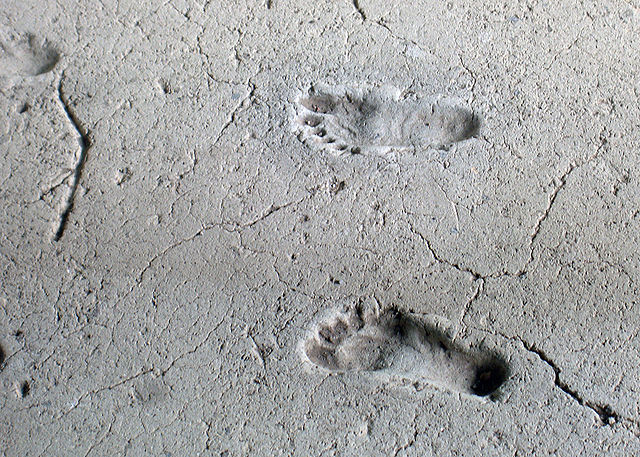
In the town of Managua, there are fossilized footprints that were left in volcanic ash and mud, and scientists think they are from over 2,000 years ago.
We just learned about the Christmas song O Holy Night.
Another famous Christmas song is O Come All Ye Faithful.
This song was first wrirten in Latin, and was called "Adeste Fidelis" which means "All Ye Faithful".
No one is really sure who wrote the words or music for this song.
A bunch of different copies of it have been found in countries like England and Portugal, and no one is really sure who wrote it first.
In 1841 the priest Frederick Oakeley wrote it in English, and those are pretty close to the words and music we use today.
The song in Latin:
Adeste fideles læti triumphantes, Venite, venite in Bethlehem.
Natum videte Regem angelorum: Venite adoremus (3×) Dominum.
Deum de Deo, lumen de lumine Gestant puellæ viscera
Deum verum, genitum non factum. Venite adoremus (3×) Dominum.
Cantet nunc io, chorus angelorum; Cantet nunc aula cælestium,
Gloria, gloria in excelsis Deo, Venite adoremus (3×) Dominum.
Ergo qui natus die hodierna. Jesu, tibi sit gloria,
Patris æterni Verbum caro factum. Venite adoremus (3×) Dominum.
The song in English:
O come, all ye faithful, joyful and triumphant! O come ye, O come ye to Bethlehem;
Come and behold him Born the King of Angels: O come, let us adore Him, (3×) Christ the Lord.
God of God, light of light, Lo, he abhors not the Virgin's womb;
Very God, begotten, not created O come, let us adore Him, (3×) Christ the Lord.
Sing, choirs of angels, sing in exultation, Sing, all ye citizens of Heaven above!
Glory to God, glory in the highest: O come, let us adore Him, (3×) Christ the Lord.
Yea, Lord, we greet thee, born this happy morning; Jesus, to thee be glory given!
Word of the Father, now in flesh appearing! O come, let us adore Him, (3×) Christ the Lord.
Another famous sculpture from Michelangelo was Bacchus.
While he was working in Florence, and before he made his famous Pieta sculpture, Michelangelo was hired to make a statue for the garden of a famous rich person.
He decided to make a sculpture of Bacchus, the mythical Roman god of wine.
The rich person did not like the statue and so he gave the statue to one of his friends.
Because it is one of his first sculptures it is very famous, and also a funny story because Michelangelo became one of the greatest artists of all time, and someone once refused one of his statues because they didn't think it was good enough.
Another part of how a monitor works is the Display Resolution.
We learned that a pixel is a picture element that helps draw a picture on the computer screen.
When you are looking at the computer, the picture will look more like a real life image depending on the pixel size, monitor size, and colors you can use.
If you have a normal sized computer monitor but you can only fit 100 pixels across and 100 pixels down, that makes for 10,000 pixels.
That seems like a lot, but computers these days usually show anything from 480,000 pixels on one screen to over 2 million pixels on one screen!
You can have the same size monitor but switch between low resolution (bigger pixels) and high resolution (small pixels) to fit in as many as you can on the screen.
In the first computers, colors were really only white or black, or sometimes green or black.
Some of the first computers made just for video games like the Atari could use 256 colors.
That might seem like a lot, but the computers today can use about 16 million different colors!
Another kind of new world monkey is the White-Faced Saki, also called the Guinan Saki, Golden-Faced Saki or Pithecia Pithecia.
This kind of monkey lives in South America, spending most of its life in the trees eating fruits, nuts and bugs.
Just like you might have guessed from their name, these monkeys a very white face that is different than the rest of their black body.
Female monkeys aren't as brightly colored as the males and will usually just have grey fur.
Yemen is a country in the middle east, bordering Saudi Arabia, Oman, and the Arabian Sea.
It is about 214,000 square miles, and has about 30 million people living there.
People in Yemen speak the Arabic language.
The flag of Yemen is sideways stripes of red, white, and black.
Red is for the blood of the people who fought for Yemen, white is for a bright future, and black is for a dark past.
To eat in Yemen you might have saltah, which is a meat stew made with fenugreek, chilies, tomatoes, garlic and herbs. These are mixed in with rice, potatoes, eggs, vegetables and served with bread.
(from: wikipedia - saltah)
Visiting Yemen, you might go to the island of Socotra, where there is a large tree called a dragon blood tree, or dracaena cinnabari.
It is called a dragon blood tree because of the red sap that comes off of the tree.
(from: wikipedia - dracaena cinnabari)
The words for this song were first written in 1843 by a French poet named Placide Cappeau.
In Roquemare France the church organ had been fixed, and the priest asked Placide to write a poem to celebrate.
In French the poem started with the words "Minuit, chrétiens! c'est l'heure solennelle" which means "Midnight, Christians, is the solemn hour".
In 1847 a musician named Adolphe Adam wrote the music to go with the poem.
After it became famous in France, it was later written in English by John Sullivan Dwight in 1855.
The song was very popular in parts of America during the Civil War with people who thought slavery was bad,
because of the words from the song: "Chains shall he break, for the slave is our brother,"
O holy night, the stars are brightly shining, It is the night of the dear Saviour’s birth;
Long lay the world in sin and error pining, 'Till he appeared and the soul felt its worth.
A thrill of hope the weary world rejoices, For yonder breaks a new and glorious morn;
Fall on your knees, Oh hear the angel voices! O night divine! O night when Christ was born.
O night, O holy night, O night divine.
Led by the light of Faith serenely beaming; With glowing hearts by his cradle we stand:
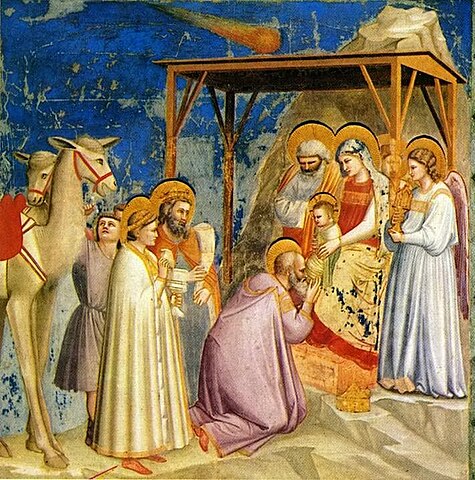
So, led by light of a star sweetly gleaming, Here come the wise men from Orient land,
The King of Kings lay thus in lowly manger, In all our trials born to be our friend;
He knows our need, To our weakness no stranger! Behold your King! Before Him lowly bend!
Behold your King! your King! before him bend!
Truly He taught us to love one another; His law is Love and His gospel is Peace;
Chains shall he break, for the slave is our brother, And in his name all oppression shall cease,
Sweet hymns of joy in grateful Chorus raise we; Let all within us praise his Holy name!
Christ is the Lord, then ever! ever praise we! His pow'r and glory, evermore proclaim!
His pow'r and glory, evermore proclaim!
Another one of the most famous artists of all time is Michelangelo.
His full name was Michelangelo di Lodovico Buonarroti Simoni, and he was born in Italy in the area now called Tuscany.
The family moved to another town called Settignano right after he was born, where his father owned a farm and a marble quarry.
When he was only 6 years old his mother died, so he was raised by his father, a nanny, and the nanny's husband.
Michelangelo said that part of the reason he was good at sculpting was because he grew up learning to use a chisel and hammer at the marble quarry.
When he was about 13 he moved to Florence for school, but was only interested in art, and was given a job as an apprentice to Domenico Ghirlandaio, the artist who painted the walls of the Sistine Chapel.
Many years later Michelangelo would be hired to paint the ceiling of the Sistine Chapel.
After making some sculptures Michelangelo later made the very famous sculpture of Pietà with Jesus being held by his mother Mary.
That sculpture helped people see how good of an artist he was, and helped him get people to hire him so he could become one of the greatest artists of all time.