Tuesday, October 29, 2019

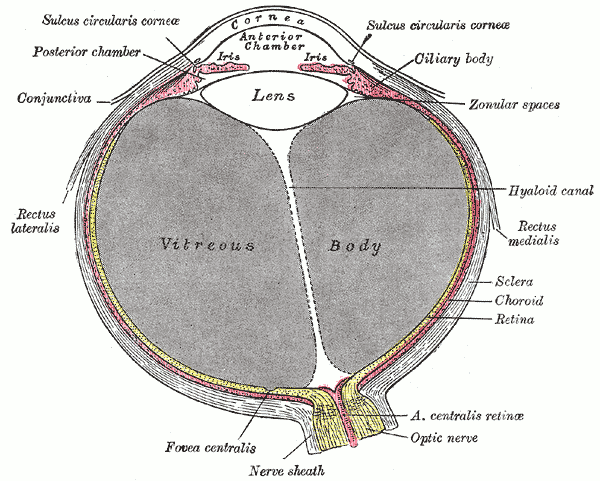
Ciliary Body


We just learned about the Fibrous Tunic where the Cornea and Sclera are.

Another part of the eyes is the Ciliary Body.

This is made up of two parts: the ciliary muscle, and the ciliary epithelium

The muscle is what squeezes the lens inside the eye to change its shape so you can look at things far away or close up.

The epithelium is what makes the aqueous humour that fills the front of the eye where the pupil is.


(from: wikipedia - ciliary body)


Kid Facts - Blast from the past: Tooth - Initiation

Monday, October 28, 2019

Czech Hedgehog


We just learned about the Dragon's Teeth used to stop tanks.

Another type of fortification is a Czech Hedgehog.

These were iron bars that were welded together in criss cross patterns and then put out on the ground to stop tanks.
The tanks couldn't drive over them, and they were too heavy to push around.
They also could not be knocked over, because even if they were tipped over they would still make the same kind of X star shape that tanks couldn't drive over.

They were called Czech Hedgehogs because they are spikey like a hedgehog, and they were first used in Czechoslovakia to protect them from German tanks during World War II.


(from: wikipedia - czech hedgehog)


Kid Facts - Blast from the past: Predjama Castle

Sunday, October 27, 2019

Leo and Attila


We just learned about the Saint Patrick who told people in Ireland about Jesus.

Another part of ancient Christianity was the meeting between Leo and Attila .

Leo was a leader called a Bishop of the church in Rome, Italy.
Rome was usually thought of as the most important city of all, so the Bishop in Rome was usually the most important Bishop and got called the "Pope".

Attila the Hun was a warrior who was attacking all over the place, and in 452 AD came to Italy to try and take over.
The Emperor of Rome sent Pope Leo and a few other people to meet Attila and try to see if they could talk to him and make him not come attack Rome.

No one knows really what was said, but after meeting with Pope Leo, Attila packed up his troops and left Italy.

A person who goes and meets with other leaders of countries is called an "Ambassador" and Pope Leo was thought to be a very good ambassador because he helped save Rome from Attila the Hun.


(from: wikipedia - pope leo i)


Kid Facts - Blast from the past: Epaphroditus - Bishop of Andriace

Saturday, October 26, 2019

Toltec Atlantean figures from Tula


We just learned about the Montezuma's Headdress.

Another famous Mesoamerican ancient sculpture is the Toltec Atlantean figures from Tula.

These are four big statues that used to be pillars that held up a roof for a building.
They are called atlantean figures, because they look kind of like sculptures of Atlas holding up the world that were found in Europe long ago.

The sculptures are in the town of Tula in the state of Hidalgo in Mexico.
No one knows for sure when they were built, but people think it was around 750 AD, by the Toltec people who lived there.

The statues are over 15 feet tall, have butterfly shaped armor, sun shields, feathered helmets, and spears.
They were warriors that were meant to serve the mythical Quetzalcoatl from ancient times in Mexico.


(from: wikipedia - atlantean figures)


Kid Facts - Blast from the past: Asura at Kōfuku-ji temple

Friday, October 25, 2019

Russian - Good Morning


We just learned a few ways to say hello and goodbye in Russian, like Привет (privet), Здравствуй (Zdravstvuy), Пока (poka) and до свидания (do svidaniya).

Sometimes you might want to say good morning, good afternoon, or good night.

Good Morning - Доброе утро (Dobroye utro) - sounds like doh-b-day oo-t-doh

Good Day - Добрый день (Dobryy den) - sounds like doh-b-day den

Good Evening - Добрый вечер (Dobryy vecher) - sounds like doh-b-day vee-chay-der

Good Night - Доброй ночи (Dobroy nochi) - sounds like doh-b-day noh-chee


russian language
(from: wikipedia - russian academy of sciences)

Norwegian: God morgen, God dag, God ettermiddag, God kveld, God natt

Greek: Καλημέρα (Kaliméra), Καλησπέρα (Kalispéra), Καληνυχτα (Kalinychta)

ASL: Good Morning, Good Day, Good Evening, Good Night

Italian: buongiorno, buon pomeriggio, buonasera, buona notte

German: Guten Morgen, Guten Tag, Guten Abend, Gute Nacht

Spanish: Buenos días, buenos tardes, buenas noches

French: bonjour, bonsoir, bonne nuit

Thursday, October 24, 2019

Cam


We just learned about the linear actuator.

Another type of actuator or moving machine is a Cam.

A cam is a disc usually on a rotor that is spinning around.
The disc is mostly shaped like a circle, but it as a part that sticks out like a bump.
The circle disc is called the camp plate, disc cam or radial cam.

When the rotor spins around, that bump part of the cam can push down on something like a shaft or a pole.
Machines can use this to push those shafts down over and over again.
So every time the rotor spins around, it pushes the shaft down and then back up.


(from: wikipedia - cam)


Kid Facts - Blast from the past: Lagari Hasan Çelebi

Wednesday, October 23, 2019

Tentacles


We just learned about the Oral Arms of a jellyfish.

Another part of a jellyfish is the Tentacles.

These are the arms that hang down from the edge of the big circular bell of the jellyfish.
The tentacles have stingers on them that help them catch prey, and then the oral arms help bring them up to their manubrium mouth.


(from: wikipedia - jellyfish)


Kid Facts - Blast from the past: Cephalopod Ink

Tuesday, October 22, 2019

Fibrous Tunic


We just learned about the Aqueous Humour.

Another part of the eye is the Fibrous Tunic.

We learned before about the clear cornea bubble at the front of the eye, and the white sclera that makes the outside white part of the eye.

These two parts together are called the fibrous tunic.
The word tunic is an old word for clothing that people wore long ago.

Sometimes the words cornea and sclera are smushed together and just called the corneosclera.


(from: wikipedia - fibrous tunic of eyeball)


Kid Facts - Blast from the past: Odontoblast

Monday, October 21, 2019

Dragon's Teeth


We just learned about the Witch Tower.

Another type of fortification is Dragon's Teeth.

Much later than the old times of swords and arrows, one of the most powerful weapons in war was the tank.

Tanks were pretty much just armored cannons on wheels, and could not be destroyed by soldiers or simple guns.
So people made other ways to stop them, like putting giant spikes into the ground that tanks could not drive over.


(from: wikipedia - dragon's teeth (fortification))


Kid Facts - Blast from the past: Bellver Castle

Sunday, October 20, 2019

Saint Patrick


We just learned about Mariology the study of Mary.

Another part of early Christianity is Saint Patrick.

Some time around 430 AD, at the age of 16 a man named Patrick was captured by pirates from the island of Ireland.
He was taken back to Ireland, and was made a slave for 6 years.

Later on he escaped and went back to his home in Britain, and learned to be a Christian.
He knew the people in Ireland were not Christian, so he decided to go back there and tell people about Jesus.

When he went there, some people listened to him and became Christians, and other people did not like him and would put him in jail.
After many years of traveling around Ireland, he helped many people become Christians, and even after he died people still believed and spread the news.

When he died, because he did such a good thing they named him a Saint, so now they call him Saint Patrick.
The day of his death was March 17th, so on that day people celebrate Saint Patrick's day, and his life of service bringing news of God to the people of Ireland.


(from: wikipedia - saint patrick)


Kid Facts - Blast from the past: Tychicus - Bishop of Colophonia

Saturday, October 19, 2019

Montezuma's Headdress


We just learned about the Teocalli of the Sacred War.

Another ancient mesoamerican work of art is Montezuma's Headdress.

This is a crown made of feathers sewn together, and decorated with some gold plates.
It is about 46 inches tall and 69 inches wide.
There are feathers from four birds: the cotinga amabilis, the roseate spoonbill, the squirrel cuckoo, and the quetzal.

Most of the feathers on the headdress are from the quetzal
.

(from: wikipedia - montezuma's headdress)


Kid Facts - Blast from the past: Kongōrikishi