Wednesday, May 29, 2019

White Spotted Jellyfish


We just learned about the Lobed Comb Jellyfish that lights up like a rainbow.

Another type of jellyfish is the White Spotted Jellyfish, also called the floating bell, Australian spotted jellyfish, or phyllorhiza punctata.

This type of jelly started out living in warm water in the Pacific ocean by Australia and Japan, but has now been found all the way over by California, and even in the Gulf of Mexico.
It grows to about 20 inches wide, and does have a sting but it doesn't really hurt humans.

They swim in large groups with other white spotted jellies, and because of this they can be harmful to other life in the ocean.
In their groups they swim along and eat all of the tiny little things like zooplankton, or eggs of crabs, shrimp or fish.
They also clog up the boat motors and cause problems with ships on the sea.


(from: wikipedia - phyllorhiza punctata)


(from: youtube - Underwater Beauty: Spotted Jellies - Shedd Aquarium)


Kid Facts - Blast from the past: Giant Cuttlefish
Tuesday, May 28, 2019

Lips


We just learned about the part on the roof of the mouth called the Palatine Raphe.

Another part of the mouth is the Lips.
The big long names for the upper and lower lips are the Labium superius oris and "Labium inferius oris.
Labium means lip, superius and inferius are for upper and lower, and then oris is for the face, near the mouth.

The lips have no sweat glands, and can not grow hair.
Skin on the lips is softer than the face skin.

Most of the skin on the face has 16 layers, but the skin on the lips only has about 4 layers.
It also doesn't have the same coloring cells as the face does, so you can see right through the top skin and see the blood vessels underneath it.
That's why the lips are pink or red, because of the blood vessels underneath.

There are a whole bunch of muscles for the lips that we learned about a while ago:
Upper lip: levator labii superioris and levator anguli oris
Lower lip: depressor anguli oris, depressor labii inferioris, mentalis

Lips are used to open and close for food, to help make sounds when we talk, and also to kiss!
Because lips are on the human face, people try very hard to make their lips look nice, sometimes using makeup or lip gloss, and sometimes even having surgery to make their lips look bigger.

The lips are very important to keep healthy, which is why there are things like lip balm to protect them.
Healthy lips help protect the mouth from the outside, and keep a healthy mouth!


(from: wikipedia - lip)


Kid Facts - Blast from the past: Central Incisors

Monday, May 27, 2019

Curtain Wall


We just learned about the hole in a castle wall called the Machicolation.

Another part of a castle is a Curtain Wall.

This is another wall that goes around the main castle, to help protect the castle inside the wall.

Its name makes sense because it's like a big curtain going around the outside of the castle.


(from: wikipedia - curtain wall (fortification))


Kid Facts - Blast from the past: Castel del Monte

Sunday, May 26, 2019

Church of the Pater Noster


We just learned about the Church of the Nativity in Bethlehem where Jesus was born.

Another part of early Christian history is the Church of the Pater Noster in Jerusalem.

In the Bible there was a place called the Mount of Olives, where Jesus appeared to the disciples and then ascended into heaven.

When the emperor Constantine sent his mother Helena out to find some of the important places in Christianity, she came to this place and made a church where the Mount of Olives was.

It's called Church of the Pater Noster because "pater" means father and "noster" means our.
In a cave below the Mount of Olives is where people believe Jesus taught his disciples the Lord's Prayer, which starts with the words "Our Father".


(from: wikipedia - church of the pater noster)


Kid Facts - Blast from the past: Luke the Evangelist

Saturday, May 25, 2019

Pisa Griffin


We just learned about the Trà Kiệu Pedestal from the ancient Champa kingdom.

Another famous sculpture is the Pisa Griffin, made around 1000 AD somewhere in Spain.

It is about 3 feet tall, and is the largest Islamic metal sculpture ever found.
It has carvings on it, and some holes.
Some people think the holes were used to make it into a fountain, and others think maybe the holes were to make sounds like a horn.

The sculpture is in Pisa, Italy now, and people think it was taken as a treasure from war long ago when some people from Italy battled some Islamic people in Spain.


(from: wikipedia - pisa griffin)


Kid Facts - Blast from the past: Six Ritual Jades - Hu

Friday, May 24, 2019

Norwegian - January, February


We just learned about the days of the week.

Let's learn about the months of the year in Norwegian!

January - Januar - sounds like yah-noo-adr
February - Februar - sounds like feh-b-doo-ah-dr

norwegian language
(from: wikipedia - norwegian language)

Greek: Ιανουάριος (Ianouários), Φεβρουάριος (Fevrouários)

ASL: January, February

Italian: Gennaio, Febbraio

German: Januar, Februar

Spanish: Enero, Febrero

French: Janvier, Février

Thursday, May 23, 2019

Forensic Dentistry


We just learned about how scientists can use Forensic Botany to figure out what kind of plants were around during a crime.

Another part of forensic science is Forensic Dentistry.

Sometimes after a crime has been committed, scientists will look at teeth to figure out what really happened.

If there was a fight between two people and one person bit the other person, they can look at the bite mark and try to match it up to the other person's teeth!

There also might be a skeleton that was found from a long time ago, and people aren't sure who it was.
If that person ever went to the dentist and had molds made of their teeth or x-rays of them, they can try to match it up and see who it was.

The teeth can also tell a scientist how old a person was when they died.
This can even be helpful for people that died hundreds of years ago, when people are digging out ancient pyramids, castles or finding cavemen!


(from: wikipedia - forensic dentistry)


Kid Facts - Blast from the past: Rocket Engine Thrust

Wednesday, May 22, 2019

Lobed Comb Jellyfish


We just learned about the small Barrel Jellyfish.

Another jellyfish is the Lobed Comb Jellyfish, also called the common northern comb jelly, or the bolinopsis infundibulum.

It grows to about 6 inches long, and lives mostly in the northern Atlantic Ocean.

This type of jelly is see through or sometimes milky white.
It has two small tentacles, and it's mouth is at one end of its body.

They have little tiny hairs along their body that they use to swim around.
On their body they have parts that light up using bioluminescence.
This means some chemicals in their body mix together to change colors and glow in the dark.


(from: wikipedia - bolinopsis infundibulum)


(from: youtube - The Lovely Lobed Comb Jelly - Monterey Bay Aquarium)

Kid Facts - Blast from the past: Mimic Octopus

Tuesday, May 21, 2019

Palatine Raphe


We just learned about the bump of skin behind your front teeth called the Incisive Papilla.

Another part of the mouth is the Palatine Raphe.

This is the bump on the roof of the mouth in the middle that goes from front to back.
Some people have a big bump that sticks out, but for others it is just a little bump.


(from: wikipedia - palatine raphe)


Kid Facts - Blast from the past: Baby Teeth

Monday, May 20, 2019

Machicolation


We just learned about the Battlements on the top of the castle where people defend from attackers.

Another part of a castle's defense is the Machicolation.

This is a place where the top of the wall sticks out a little and there is a hole where people can drop things down on attackers.
It isn't a low spot in the wall like a crenel, the wall is still high there like a merlon, but it sticks out.
In the old days people would use that spot to drop big rocks or pour hot water or oil on people trying to break into the castle.

One famous machicolation we already learned about is at Blarney Castle in Ireland.
The stone on the bottom of the machicolation is called the Blarney Stone, and kissing it is for good luck!


(from: wikipedia - machicolation)


Kid Facts - Blast from the past: Schwerin Castle

Sunday, May 19, 2019

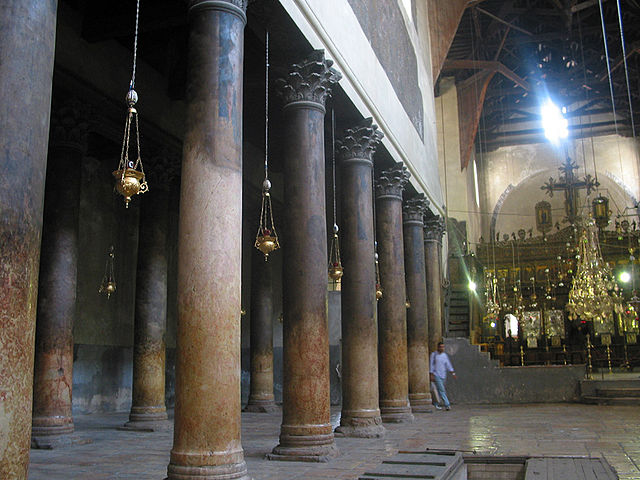
Church of the Nativity


We just learned about Saint Helena, the mother of Constantine.

Another part of early Christianity is the Church of the Nativity.

After the emperor Constantine became a Christian, he sent his mother Helena out on a trip called a pilgrimage to go and find some of the holy places from the history of the Bible.

She went to Bethlehem and found the place where Jesus was born.
After she found it, she set up a church there, and it has been there for over 1,600 years, since 327 AD.

In the church there is a spot on the ground where people believe Mary was when Jesus was born.
There is a 14 pointed star on the ground, with a circle hole in the middle.
The points on the star are for the history of Jesus' family from Abraham to David, David to when the Hebrews were captured in Babylon, and then from that time to Jesus.
Where the hole is in the middle is a stone that you can touch, that people believe is the actual stone from when Jesus was born.


(from: wikipedia - church of the nativity)


Kid Facts - Blast from the past: Mark the Evangelist