Sunday, January 12, 2020

Muslim Conflict


We just learned about the Church of the East in China.

Another part of early Christianity was the Muslim Conflict.

Around 610 AD, a man named Muhammad started a new religion called Islam, and the followers of Islam are called Muslims.

Christianity and Islam were both spreading around Europe, the Middle East and Africa all through the years 600 AD and 700 AD, and people fought over which one was true.

Most of the countries in the Middle East, northern Africa, and even Spain and Portugal became mostly Muslim.

Christianity was still spreading into Western Europe, but many countries that used to be Christian switched to Islam for hundreds of years.


(from: wikipedia - spread of islam)


Kid Facts - Blast from the past: Quartodecimanism

Saturday, January 11, 2020

The Willing Captive - Chauncey Ives


We just learned about the Clasped Hands of Robert and Elizabeth Barrett Browning by Harriet Hosmer.

Another The Willing Captive by Chauncey Ives in 1886.

Ives was born in Connecticut, and when he was a teenager he started learning how be a sculptor.
After a few jobs he moved to Italy to learn from other masters there.

In 1886 he made a sculpture of a young woman who was captured by Native Americans. After staying with the Natives for a while, her mother came to take her back, but she wasn't sure if she wanted to stay with the Natives or go back to her mother.

There are true stories like these where Natives would capture young girls and raise them as their own, and sometimes the girls would decide to stay with the Natives instead of going back home.


(from: wikipedia - chauncey ives)


Kid Facts - Blast from the past: Indus Valley Civilization

Friday, January 10, 2020

Russian - Black, white, brown, gray

We just learned that in Russian, red, orange and yellow are красный (krasnyy), оранжевый (oranzhevyy), желтый (zheltyy),
and green, blue, purple, pink are зеленый (zelenyy), синий (siniy), фиолетовый (fioletovyy), розовый (rozovyy).

Let's learn some more colors!

black - черный (chernyy) - sounds like choh-r-nee 文A

white - белый (belyy) - sounds like bee-ah-lee 文A

brown - коричневый (korichnevyy) - sounds like kah-dree-ch-nee-yeh-vee 文A

gray - серый (seryy) - sounds like see-ah-dree 文A


russian language
(from: wikipedia - russian academy of sciences)

Norwegian: svart, hvit, brun, grå

Greek: μαύρο, λευκό, καφέ, γκρι

ASL: black, white, brown, gray

Italian: nero, bianco, marrone, grigio

German: schwarz, weiß, braun, grau

Spanish: negro, blanco, marrón, gris

French: noir, blanc, brun, gris

Thursday, January 9, 2020

Valve Trim


We just learned about the Valve Spring.

Another part of the valve is the Valve Trim.

The valve stem, seat, disc and any parts that are inside the valve are all together called the Valve Trim.


(from: wikipedia - valve)


Kid Facts - Blast from the past: The Rocket into Planetary Space - Hermann Oberth

Wednesday, January 8, 2020

Jellyfish Ephyra


We just learned about the Jellyfish Polyps.

Another part of a jellyfish is the Ephyra.

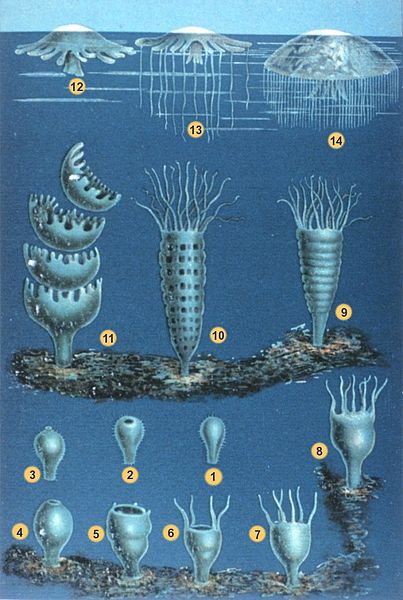
After the polyps grow for a little while, they start to grow parts that look more like a jellyfish.
It starts to get a bell shape, grow some tentacles and even mouth parts.
Eventually it floats away and is like a mini-jellyfish, not quite grown yet.

This part of the jellyfish's life is known as the Ephyra.

Later on it grows up a little more and is called a Medusae, which is the science word for the jellyfish species.


(from: wikipedia - ephyra)


Kid Facts - Blast from the past: Radula

Tuesday, January 7, 2020

Optic Disc


We just learned about the Opthalmic Artery.

Another part of the eye is the Optic Disc.

At the back of the eye there is a place where all the nerves come together and go out to the brain.
Because this spot has nerves, there are no rods or cones there, so it is like a blind spot in your sight.

There are some fun eye tests that you can do to actually show that you have a blind spot where things disappear from your sight!


(from: wikipedia - optic disc)


Kid Facts - Blast from the past: Masticatory Mucosa

Monday, January 6, 2020

Larsen Ice Shelf


We just learned about the Antarctic Ice Sheet.

Another part of Antarctica is the Larsen Ice Shelf.

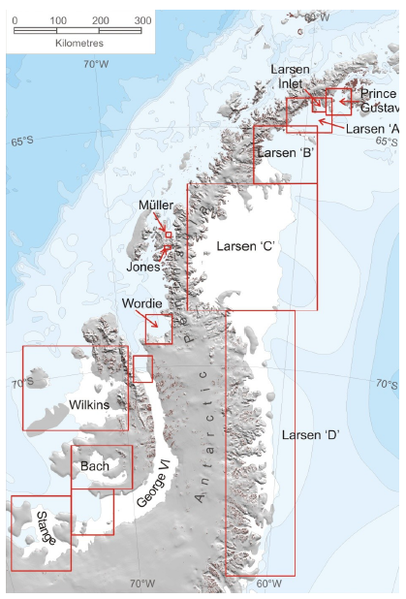
This is the shelf of ice that's on the Antarctic Peninsula.
An ice shelf is a big piece of ice that goes out from the land and has water underneath it.

The Larsen Ice Shelf used to be about 33,000 square miles, but because of global warming it has gotten 7,000 square miles smaller and is now 26,000 square miles.

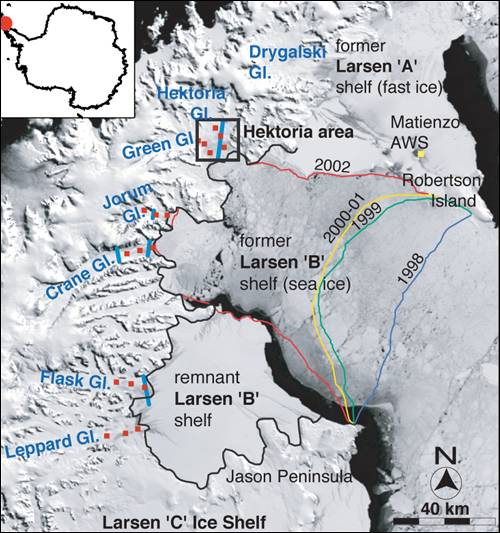
The ice shelf is split up into parts A, B, C, D, E, F and G.

Shelf A melted away in 1995 and is gone. It was about 500 square miles, twice the size of the city of Chicago.

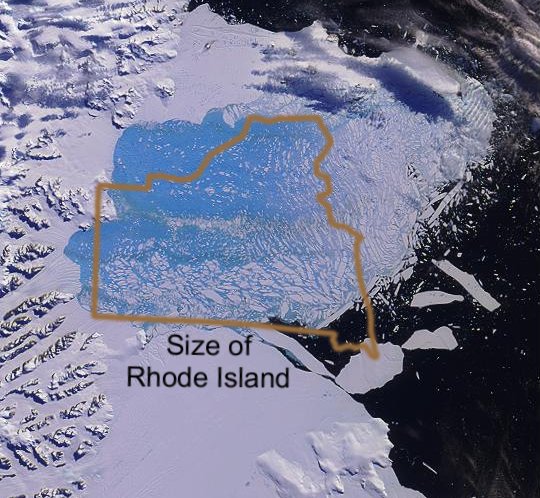
Shelf B is almost gone, and in 2002 over 1,250 square miles broke off and floated away. That is about the size of the state of Rhode Island. This ice shelf had not melted for over 10,000 years.

Shelf C is melting and breaking away also. It is 17,000 square miles. In 2017 a 2,200 square mile piece broke off and floated away. This iceberg was called A68, weighed more than a trillion tons, and was taller than a 70 story building.

Shelf D has not broken away so far and is about 8,000 square miles.


(from: wikipedia - larsen ice shelf)


Kid Facts - Blast from the past: Castillo de Coca