Friday, October 11, 2019

Norwegian - Vegetables


We just learned how to say some fruits in Norwegian.

Let's learn how to say some vegetables.

carrot gulrot - sounds like goo-l-droh-t
corn mais - sounds like mah-ees
pea erter - sounds like ah-ter

norwegian language
(from: wikipedia - norwegian language)

Greek: καρότο (karóto), καλαμπόκι (kalampóki), μπιζέλι (bizéli)

ASL: carrot, corn, pea

Italian: carote, mais, piselli

German: Karotte, Mais, Erbse

Spanish: zanahoria, maíz, guisante

French: carotte, maïs, pois

Thursday, October 10, 2019

Rack and Pinion


We just learned about the Air Gap in a motor.

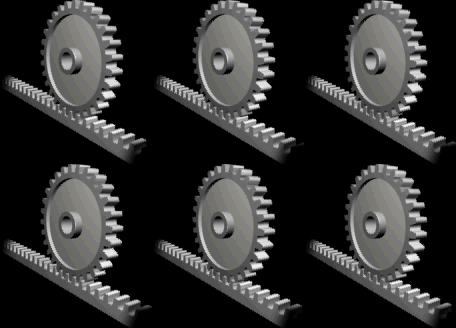
Another type of thing used in machines is the Rack and Pinion.

A pinion is a gear, which we learned is a circle with teeth on the end.
The rack is a long flat line that has teeth on it, that match up with the gear.

When the gear spins around, it goes along the rack one way or the other.
These can be used as pinion wheels for something like a train that goes along a rack track, or sometimes as a pinion wheel that climbs up and down a pole that has a rack on it.


(from: wikipedia - rack and pinion)


Kid Facts - Blast from the past: Shock Diamond

Wednesday, October 9, 2019

Manubrium


We just learned about the Gastrodermis that helps the jellyfish eat.

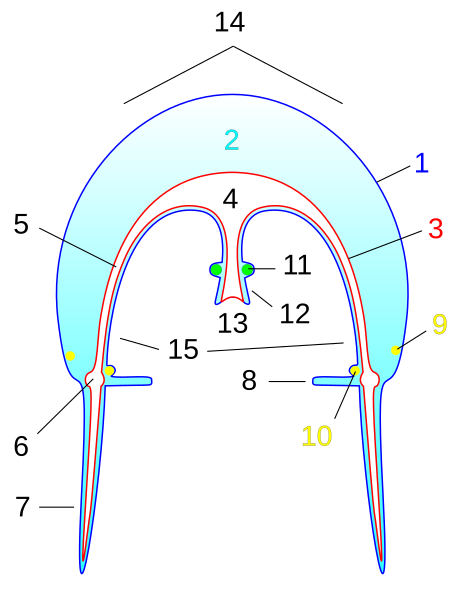
Another part of the jellyfish's body is the Manubrium.

This is a part that hangs down from the middle of the inside of the jellyfish.
They use it to eat, and also to get rid of waste.


(from: wikipedia - jellyfish)


Kid Facts - Blast from the past: Octopus Gills

Tuesday, October 8, 2019

Vitreous Body


We just learned about the Macula in the back of the eye.

Another part of the human eye is the Vitreous Body.

Inside the eye, most of it is filled up with a kind of clear gooey gel.
It's clear like water, but is thicker almost like jelly.

This is called the vitreous body, or sometimes the vitreous humor.
It helps the eye keep its shape, and it helps keep the vision clear between the lens and the retina.


(from: wikipedia - vitreous body)


Kid Facts - Blast from the past: Tooth Root

Monday, October 7, 2019

Trou de Loup


We just learned about the Abatis tree fortification.

Another type of fortification is the Trou de Loup, which is French for Wolf Hole.

This is a hole used as a trap that people would dig in front of the castle, and then cover up with something like straw or sticks so people didn't see it until they walked right on top of it.


(from: wikipedia - trou de loup)


Kid Facts - Blast from the past: Château de Chantilly

Sunday, October 6, 2019

Saint Augustine of Hippo


We just learned about the Saint Ninian in Scotland.

Another person from early Christianity is Saint Augustine of Hippo.

Saint Augustine wrote over 50 books, that helped Christians understand the Bible.

His most famous ones were:

- The City of God: In the year 410 the city of Rome was attacked and defeated by some other people who didn't believe in God. Many people were nervous that this would mean the end of Christianity, so he wrote this book to help give people hope.

- On Christian Teaching: This book helps people understand the books of the Bible, and tells Christian teachers and preachers how to teach the truth.

- Confessions: This was Saint Augustine's book about his own life, and how he became a Christian and asked for forgiveness.

He wrote many other books about things like the Trinity and about people needing free will to believe in God.


(from: wikipedia - augustine of hippo)


Kid Facts - Blast from the past: Sosipater - Bishop of Iconium

Saturday, October 5, 2019

The Wrestler


We just learned about the Were-Jaguar Sculpture.

Another ancient Mesoamerican sculpture is The Wrestler.

This is a sculpture of a sitting man, made out of an igneous rock called basalt.

The man has his arms out and bent, and one leg forward and one leg back.
Because he looks like he is moving, some people thought it looked like he was getting ready to wrestle.
Historians don't think he was actually supposed to be a wrestler, but maybe someone doing a special ceremony.

This statue doesn't have special markings to say when it was made, so people are not really sure if it was made around 400 BC or around 1500 BC!

It was found in the Mexico state of Veracruz in 1933.


(from: wikipedia - the wrestler (sculpture))


Kid Facts - Blast from the past: Shaka Triad of Hōryūji - Tori Busshi

Friday, October 4, 2019

Norwegian - Fruits


We just learned how to say some things to drink in Norwegian.

Let's learn how to say some fruits.

apple eple - sounds like eh-pleh
orange appelsin - sounds like ah-peh-l-seen
banana banan - sounds like bah-nah-n

norwegian language
(from: wikipedia - norwegian language)

Greek: μήλο (mílo), πορτοκάλι (portokáli), μπανάνα (banána)

ASL: apple, orange, banana

Italian: mela, orange, banana

German: Apfel, Orange, Banane

Spanish: manzana, naranja, banana

French: pomme, orange, banane

Thursday, October 3, 2019

Air Gap


We just learned about the Electromagnet.

Another part of the electric motor is the Air Gap.

We learned that the rotor is the part that spins around in the middle, and the stator is the part that is wrapped around it.

The very small space between the rotor and the stator is the air gap.

The smaller the air gap, the better the electric motor will work, but it also needs to be enough space that the rotor won't hit the stator as it is spinning around.


(from: wikipedia - electric motor)


Kid Facts - Blast from the past: Multistage Rocket

Wednesday, October 2, 2019

Gastrodermis


We just learned about the jellyfish Mesoglea underneath the bell.

Another part of a jellyfish's body is the Gastrodermis.

This is the part below the mesoglea.
The gastrodermis helps the jellyfish digest the food that gets brought up to their mouth.


(from: wikipedia - gastrodermis)


Kid Facts - Blast from the past: Mantle

Tuesday, October 1, 2019

Macula


We just learned about the Sclera whites of the eyes.

Another part of the eye is the Macula.

This is an oval shaped darker spot on the retina in the back of the eye.
The macula helps you see very detailed colors in bright daylight.

If there is a big picture with lots of colors and shapes, your macula helps you see it all clearly.
Sometimes when people get old their macula doesn't work as well anymore, which can cause blurry vision.


(from: wikipedia - macula of retina)


Kid Facts - Blast from the past: Crown

Monday, September 30, 2019

Abatis


We just learned about the Fujian Tulou.

Another type of fortification is an Abatis.

During a battle, sometimes people will chop trees down and lay them on the ground with the branches facing toward the enemy.
They tie them together with ropes or wires so they can't be moved out of the way.

This makes it very hard for the enemy to climb through, and helps keep away the attackers.


(from: wikipedia - abatis)


Kid Facts - Blast from the past: Peleș Castle

Sunday, September 29, 2019

Saint Ninian in Scotland


We just learned about the Latin Vulgate Bible.

Another part of early Christian history is Saint Ninian in Scotland.

The center of emperor Constantine's missions to spread Christianity to the Roman empire was in Constantinople, in what is now called Turkey.
It spread west, to Greece, Italy, France and Spain, and even all the way to England.

North of England is the country of Scotland, and at the time there were people living there known as "Picts".
They worshiped animals, trees and all sorts of other mythological things.

A man named Ninian went to visit Scotland around 400 AD to talk to the Picts and tell them about Jesus and Christianity.
He built a church in the town of Whithorn and called it "Candida Casa" which means white house, and many of the Picts became Christians.


(from: wikipedia - ninian)


Kid Facts - Blast from the past: Jason - Bishop of Tarsus

Saturday, September 28, 2019

Were-Jaguar Sculpture


We just learned about the Aztec Sun Stone.

Another ancient Mesoamerican sculpture is the Were-Jaguar Sculpture.

Some time before 600 BC in the area of Mexico there were a bunch of sculptures created that showed people that seemed to be part jaguar and part human.
Kind of like a werewolf, but with a jaguar so they called it a were-jaguar.

People these days are not really sure what this meant back then, if it was something worshipped by people long ago or if it was some old story, but there are a bunch of these were-jaguar sculptures.

One of them is very famous, and is called the Las Limas figure.
It is about 22 inches tall and shows a person holding a little were-jaguar baby.
The statue is made of greenstone, which means it was made from one of the many greenish rocks found in the area, like omphacite or olivine.

Were-jaguar sculptures had a dip in the top middle of their head, almond shaped eyes with round irises, a frowning mouth with the upper lip lifted up, and gums with no teeth.


(from: wikipedia - werejaguar)


Kid Facts - Blast from the past: Haniwa

Friday, September 27, 2019

Norwegian - Drinks


We counted to 900 in Norwegian! Wow!

Let's learn how to say some things to drink.

water vann - sounds like vah-n
milk melk - sounds like melk
juice juice - sounds like yoo-s

norwegian language
(from: wikipedia - norwegian language)

Greek: water νερό (neró), milk γάλα (gála), juice χυμό (chymó)

ASL: water, milk, juice

Italian: acqua, latte, succo

German: Wasser, Milch, Saft

Spanish: agua, leche, jugo

French: eau, lait, jus

Thursday, September 26, 2019

Electromagnet


We just learned about the Windings.

Another part of an electric motor is the Electromagnet.

An electromagnet is a bunch of wire wrapped around a pole, and the wire has electricity going through it.
The electricity and the winding of the wire creates an invisible field that can be used to charge or move metals.

In an electric motor, the electromagnet is what helps spin the rotor around inside the stator using electromagnetism.


(from: wikipedia - electromagnet)


Kid Facts - Blast from the past: Lift

Wednesday, September 25, 2019

Mesoglea


We just learned about the Jellyfish - Epidermis.

Another part of the jellyfish body is the Mesoglea.

Underneath the bell part of the jellyfish is an open area that is made up of water and some other gooey stuff called collagen.
It's almost like a balloon full of jelly that helps the jellyfish keep it's shape in the water.


(from: wikipedia - mesoglea)


Kid Facts - Blast from the past: Octopus Beaks

Tuesday, September 24, 2019

Sclera


We just learned about the Optic Nerve that brings the eyes signals back to the brain.

Another part of the eye is the Sclera.

This is the name for the white part of the eye.
It is made up mostly of connective tissues called collagen and elastic fiber.


(from: wikipedia - sclera)


Kid Facts - Blast from the past: Pulp

Monday, September 23, 2019

Fujian Tulou


We just learned about the Meurtrière.

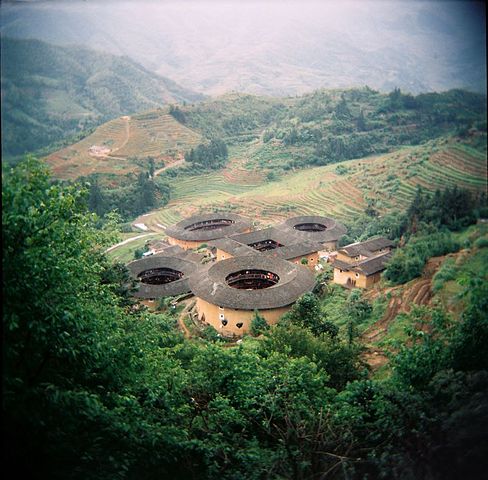
Another type of castle fortification is the Fujian Tulou.

This is a circle shaped building that is made out of dirt that is packed in tight, and mixed in with stone, bamboo and wood.
On the inside of the building are rooms for people to live in.
The top part of the buildings has gun holes to help fight against people that are attacking.


(from: wikipedia - fujian tulou)


Kid Facts - Blast from the past: Citadel of Qaitbay

Sunday, September 22, 2019

Latin Vulgate Bible


We just learned about the The Great Persecution - Persia.

Another part of early Christianity was the Latin Vulgate Bible, made in 382 AD by Saint Jerome.

The original writings in the Bible from the Old Testament to the New Testament were in all different languages.
Some of the books were in the languages of Hebrew, Aramaic, and Greek.
So if someone wanted to read the whole Bible they had to know how to speak three different languages!

Some people had translated a few parts of the Bible into Latin, which was the most commonly spoken language in the Roman empire.

A man named Jerome was given the job of putting together one whole copy of the Bible in Latin, and trying to make it as perfect as possible with no mistakes.
Jerome did such a good job that he is called Saint Jerome, and the Bible that he made called the Vulgate became the most trusted Bible anywhere.
Even today some churches use the Latin Vulgate version for some of their church services in Latin.


(from: wikipedia - vulgate)


Kid Facts - Blast from the past: Lucius - Bishop of Laodicea in Syria

Saturday, September 21, 2019

Aztec Sun Stone


We just learned about the La Mojarra Stela 1.

Another famous Mesoamerican sculpture is the Aztec Sun Stone, made some time around 1500 AD in Mexico.

This stone is about over 11 feet wide, and over 3 feet thick.

The design of the stone is split up into a few different parts.

The very middle is a sculpture of a face that people think was the sun god that the people believed in.
Around the face are four squares representing symbols for past times. The jaguar, wind, rain and water.

The first circle around that is a type of calendar, with different parts of the year shown as symbols like crocodiles, monkeys or dogs.

The second circle has sculptures of arches, feathers, and different lines that people think are for the suns rays.

The last circle on the outside has two big serpents meeting face to face, that have flame carvings all over their bodies.

(from: wikipedia - aztec sun stone)


Kid Facts - Blast from the past: Shakōki-dogū

Friday, September 20, 2019

Norwegian - Nine Hundred


We counted to 100 in Norwegian, let's keep going!

200 to hundre - sounds like too hoo-n-d-r-uh
300 tre hundre - sounds like t-day hoo-n-d-r-uh
400 fire hundre - sounds like fee-dah hoo-n-d-r-uh
500 fam hundre - sounds like fah-m hoo-n-d-r-uh
600 seks hundre - sounds like seh-ks hoo-n-d-r-uh
700 syv hundre - sounds like see-v hoo-n-d-r-uh
800 åtte hundre - sounds like oh-tuh hoo-n-d-r-uh
900 ni hundre - sounds like nee hoo-n-d-r-uh


And here are some of the even bigger numbers!

one thousand ett tusen - sounds like eh-t too-sen
one million en million - sounds like mee-lee-ohn
one billion en milliard - sounds like eh-n mee-lee-a-rd
one trillion en trillion - sounds like eh-n t-dee-lee-oh-n
one google en google - sounds like eh-n goo-ghel

norwegian language
(from: wikipedia - norwegian language)

Greek: διακόσια (diakósia), τριακόσια (triakósia), τετρακόσια (tetrakósia), πεντακόσια (pentakósia), εξακόσια (exakósia), επτακόσια (eptakósia), οκτακόσια (oktakósia), εννιακόσια (enniakósia)

ASL: two hundred, three hundred, four hundred, five hundred, six hundred, seven hundred, eight hundred, nine hundred

Italian: duecento, trecento, quattrocento, cinquecento, seicento, settecento, ottocento, novecento

German: zweihundert, dreihundert, vierhundert, fünfhundert, sechshundert, siebenhundert, achthundert, neunhundert

Spanish: doscientos, trescientos, cuatrocientos, quinientos, seiscientos, sietecientos, ochocientos, novecientos

French: deux cent, trois cent, quatre cent, cinq cent, six cent, sept cent, huit cent, neuf cent

Thursday, September 19, 2019

Windings


We just learned about the Stator in an electric motor.

Another part of an electric motor is the Windings.

These are the metal wires that are wrapped around the stator or the rotor.
They are wrapped in loops around and around, and when electricity goes through these wires it creates something called an electric or magnetic field that can spin the rotor around.

This works kind of like magnets that can move metal without even touching them.


(from: wikipedia - electric motor)


Kid Facts - Blast from the past: Air Resistance

Wednesday, September 18, 2019

Jellyfish Epidermis


We just learned about the Jellyfish Bell.

Another part of the jellyfish is the Epidermis.

The epidermis is the skin on the outside of the bell.
Just like humans, jellyfish have skin, and their epidermis has a bunch of nerves in it called a "nerve net".

This nerve net helps them feel movement in the water and tell their body where to try and swim to get food.


(from: wikipedia - jellyfish)


Kid Facts - Blast from the past: Japanese Flying Squid

Tuesday, September 17, 2019

Optic Nerve


We just learned about the Lens in the eye that helps focus light for us to see.

Another part of the eye is the Optic Nerve.

We learned before about the retina in the back of the eye that takes the light from the eye and turns it into signals that the brain can understand.

The retina is connected to a big long nerve called the optic nerve.

This nerve takes the signals from the retina and carries them all the way to the back of the brain, to the part of the brain called the occipital lobe where the signals from the eyes get turned into pictures for the brain to understand.


(from: wikipedia - optic nerve)


Kid Facts - Blast from the past: Cementum

Meurtrière


We just learned about the Battery Tower in a castle.

Another type of fortification is the Meurtrière, also called a murder hole.

These were holes in the ceiling where people from above could throw rocks, shoot arrows or pour hot water on attackers to keep them out of the castle.


(from: wikipedia - murder hole)


Kid Facts - Blast from the past: Windsor Castle

Sunday, September 15, 2019

The Great Persecution - Persia


We just learned about the city of Constantinople.

Another part of early Christianity is the The Great Persecution - Persia.

The great persecution is the name for when Christians were killed or put in jail for being Christian.
It had happened in Rome a long time ago, until Constantine took over.

After he created the city of Constantinople and was the ruler of the Roman empire, some of the other countries did not like him and were worried that he would come and try to take them over.

In the country of Persia, there was an emperor named Shapur II who was at war with the country of Rome.
The leader of the Christian church in Persia was named Simeon Barsabae.
Shapur II got angry with him and all the other leaders of the church because they were Christian, and the Roman empire was the head of the Christian church, so he killed Simeon and thousands of other Christians to try and stop Christianity from coming into his country.


(from: wikipedia - shemon bar sabbae)


Kid Facts - Blast from the past: Olympus and Rhodion

Saturday, September 14, 2019

La Mojarra Stela 1


We just learned about the Double Headed Serpent.

Another ancient sculpture from Mesoamerica is the La Mojarra Stela 1 made some time before 200 AD, in Veracruz Mexico.

We've learned before that a stele or stela is a tall stone or wooden slab that has carvings and usually writings on it, to honor someone that died, someone winning a battle, or an important set of words that people need to remember.

This stela is a carving of an warrior in a costume, and it has some writing on it about the warrior.


(from: wikipedia - la mojarra stela 1)


Kid Facts - Blast from the past: Eight Nested Relic Boxes